
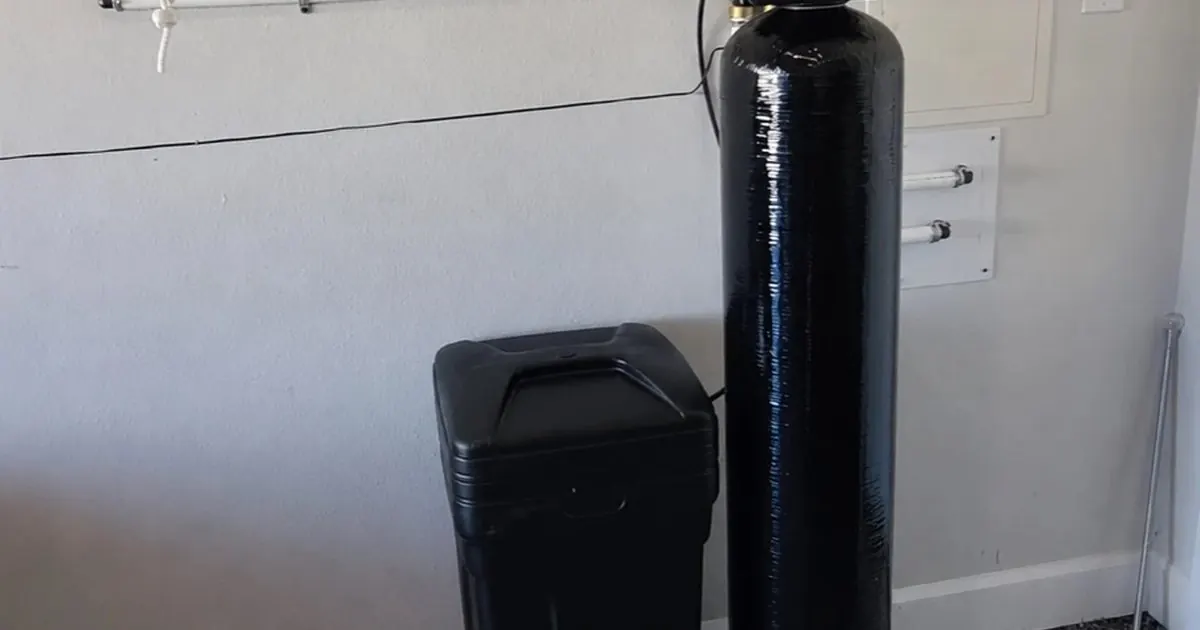
For most South Florida homes, a salt-based water softener is the right choice. It is the only residential system that actually removes the calcium and magnesium that make our tap water very hard, which is what gives you softer skin and hair, spot-free glassware, and appliances that last longer. A salt-free conditioner never removes those minerals — it can only help scale stick a little less — so it makes sense mainly when you have no drain access or you only want mild scale control.
Why this choice matters more in South Florida
Our municipal water comes from the Biscayne aquifer, a shallow layer of porous limestone. Water moving through limestone picks up dissolved calcium and magnesium, which is why tap water across Miami-Dade, Broward and Palm Beach commonly measures 200 to 350 ppm of hardness. On the USGS hardness scale, anything over 180 mg/L is “very hard.”
This water is treated and tested to meet EPA standards and is legally safe to drink. The problem is what hardness does around the house: chalky scale on fixtures, spots on dishes, soap that will not rinse clean off skin and hair, and water heaters that wear out sooner than they should. Our guide to Florida tap water covers the full picture.
How a water softener works
A softener uses ion exchange. Inside the tank is a bed of tiny resin beads. As water flows through, the beads grab the calcium and magnesium ions and release a small amount of sodium in their place. The hardness minerals stay behind, and the water that comes out is truly soft.
When the beads fill up, the control valve runs a rinse cycle called regeneration. It draws salty water from the brine tank through the resin, flushes the trapped minerals down a drain, and resets the beads. Your only job is to keep salt in the brine tank.
Our Complete System uses ResinTech CG10-HP 10% crosslinked resin (WQA Gold Seal, NSF/ANSI/CAN 61 and 372) with a 48,000-grain capacity and a Hankscraft Runxin Rev4 ceramic-disc valve rated for 28 gallons per minute. More on sizing in our water softener guide for South Florida.
How a salt-free conditioner works
Most salt-free units use template-assisted crystallization, or TAC. Water passes over a media that nudges the dissolved calcium and magnesium into tiny crystals. The idea is that these crystals are less likely to stick to pipes and heating elements, so scale may build up more slowly.
Here is the key point: the minerals are still in your water. A conditioner does not remove anything. It does not trade ions, it does not regenerate, and it needs no salt or drain. That is its main advantage. But it also means the water is not soft, and a hardness test reads the same coming out as going in.
These units are sometimes sold as “salt-free softeners,” but that name is misleading. If the calcium and magnesium are still there, the water has not been softened.
Side by side: what you actually notice at home
- Skin and hair. Soft water rinses soap and shampoo away cleanly, so skin feels less dry and hair less coated. With a conditioner, the minerals are still present, so that filmy feeling stays.
- Soap and detergent. Soft water lathers easily and you use less of everything. Conditioned water lathers less, because the hardness that fights soap is untouched.
- Glassware and shower doors. Soft water dries without spots. Conditioned water still leaves white spots, since the minerals are still there when the water evaporates.
- Fixtures. Softening stops new scale from forming. A conditioner may make scale less likely to stick, but you will still be wiping.
- Water heater and appliances. Soft water keeps heating elements free of scale, which is the main reason they last longer. A conditioner offers partial protection at best.
If you want water that feels and acts soft, only a softener delivers.
Not sure what’s actually in your water?
Get a free in-home water test. A certified Biscayne Water technician checks 14 contaminants on the spot and gives you straight answers — no obligation, no pressure.
Cost of ownership: the salt math
The biggest knock on softeners is maintenance. Here is what to expect.
- Softener salt runs about $8 to $10 per 40-pound bag.
- A refill takes 4 to 5 bags, so about $32 to $50 per refill.
- Most households refill roughly every 6 to 12 months, depending on use.
That works out to somewhere between $32 and $100 a year in salt for a typical family. Prices are estimates and may change. The equipment is covered for the long haul: lifetime on the tank, 10 years on the control valve and electronics, and 1 year on labor. We service everything we install for as long as you own the home.
A salt-free conditioner has no salt to buy and no drain to run, so routine upkeep is minimal. The trade-off is that you do not get soft water. Before buying one, ask about the media replacement schedule and cost, because no filter media lasts forever. Before buying one, ask about the media replacement schedule and cost, because no filter media lasts forever.
Our Complete System — whole-home filtration, softener and tankless reverse osmosis, installed — is $3,492, which is 30% off the regular $4,989. With financing, that is about $194 a month at 0% APR for 18 months, or about $46 a month at 9.99% APR over 120 months, subject to credit approval.
When a salt-free conditioner is a reasonable choice
A salt-free unit is worth considering when:
- You have no practical drain access. A softener needs a drain for its rinse water and a standard outlet for the valve. Some condos and older homes make that hard to add.
- Your HOA or building rules limit what you can install. If softener discharge is restricted where you live, a conditioner avoids the issue.
- You only want to slow scale on the water heater. If soft-feeling water, spot-free glass and better lather are not on your list, a conditioner may be enough.
- You want very little maintenance. No bags to carry, no brine tank to check.
Just go in with clear expectations. You are buying scale reduction, not soft water.
When a softener is clearly the better choice
For the large majority of homes we visit, the answer is a softener. It is the clear winner when:
- Your hardness tests in the normal South Florida range of 200 to 350 ppm.
- You want softer skin and hair, and dishes and shower glass that dry without spots.
- You are protecting a new water heater, dishwasher, or washing machine.
- You have a drain and an outlet near where your main water line enters the house. Most single-family homes we see do.
A softener also pairs with the rest of a complete setup. Whole-home carbon filtration upstream handles chlorine, chloramine and their by-products, and reverse osmosis at the kitchen tap handles dissolved contaminants in your drinking water. Our comparison of reverse osmosis vs. whole-home filtration explains how the three work together.
What we recommend for most South Florida homes
If you live in a single-family home in Miami-Dade, Broward or Palm Beach and have a drain nearby, get a salt-based softener. Our water is simply too hard for a conditioner to give you the results most people are hoping for, and the salt cost is modest.
If you cannot run a drain or your building will not allow it, a conditioner is a fair second choice for scale control, as long as you know what you are and are not getting.
The surest way to decide is to see your own numbers. We offer a free 14-point in-home water test that checks hardness, chlorine, pH, TDS, iron and more, with results on the spot and no obligation. Book your free test and we will come to you. Biscayne Water has been family-owned and serving South Florida since 2009, and there is never a high-pressure pitch.