
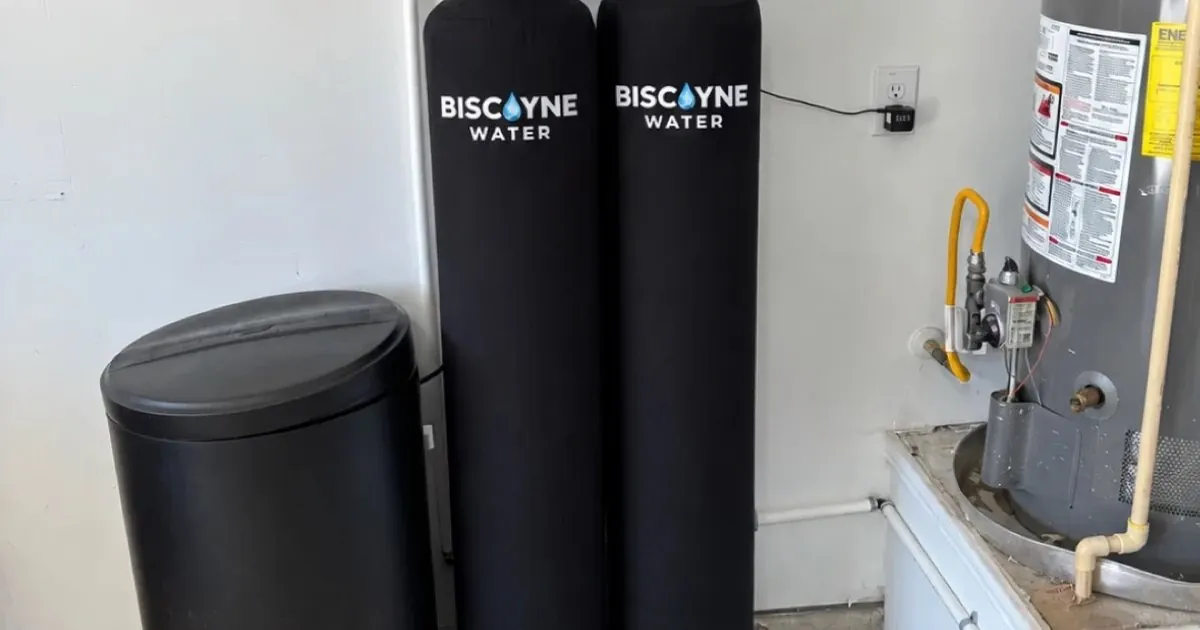
For most South Florida homes, yes, a water softener is worth it. Our tap water comes from the Biscayne aquifer and commonly measures 200 to 350 ppm hardness, which is “very hard” on the USGS scale, so scale on the water heater, spots on glass and soap film on your skin are built into the water itself. A salt-based softener is the only residential method that actually removes those hardness minerals, and once it is installed, its main regular cost is salt, about 4 to 5 bags every 6 to 12 months.
Why Florida water is so hard
Miami-Dade, Broward and Palm Beach counties draw their drinking water from the Biscayne aquifer, a shallow layer of porous limestone just under our feet. As rainwater soaks through that limestone, it picks up calcium and magnesium. Those two minerals are what “hardness” means.
Your utility treats and tests the water to meet EPA standards, and it is legally safe to drink. Those standards are about safety, not hardness, so the water that reaches your house is still very hard. Across South Florida, municipal water commonly measures 200 to 350 ppm of hardness. The USGS scale calls anything over 180 mg/L “very hard.” If you want to know what else is in the supply, we cover it in Florida tap water: what’s in it.
What hard water costs you over time
Hard water works slowly. Most of the cost shows up years later as a repair bill or a replacement you did not plan on.
- Water heater. Heating water makes dissolved minerals drop out and crust over the tank bottom or heating element. The heater works harder through that layer and wears out sooner.
- Appliances. Dishwashers, washing machines, ice makers and coffee makers collect the same scale in their small parts, and it shortens their working life.
- Fixtures. The white crust on showerheads and faucet aerators is hardness scale. It clogs spray holes and leaves a chalky ring that comes back no matter how often you clean.
- Glass and dishes. Spots and cloudiness on glasses are mineral deposits left behind as water dries.
- Soap, skin and hair. Hardness minerals keep soap from lathering, so you use more, and what does not rinse away stays on skin and hair as a filmy residue.
We will not hand you a made-up savings number. What we can say is that every one of these problems comes from the minerals, and none go away until the minerals do.
What changes day to day with a softener
A softener works by ion exchange. Water passes through a tank of resin beads that grab the calcium and magnesium and release a small amount of sodium in their place. When the beads fill up, the system rinses them with salt water from the brine tank and sends the minerals down the drain. It does this on its own.
What homeowners notice first:
- Soap lathers with less and rinses off clean, so the filmy residue on skin and hair goes away.
- Glasses come out of the dishwasher clear instead of spotted.
- No new crust forms on fixtures, tile or the shower door.
- The water heater and appliances stop collecting new scale.
Biscayne’s Complete System uses ResinTech CG10-HP 10% crosslinked resin (WQA Gold Seal, NSF certified) with a 48,000-grain capacity, run by an NSF-certified Hankscraft Runxin Rev4 ceramic-disc control valve.
Not sure what’s actually in your water?
Get a free in-home water test. A certified Biscayne Water technician checks 14 contaminants on the spot and gives you straight answers — no obligation, no pressure.
What a softener does not do
This is the part many sales pitches skip. A softener is not a filter. It is built to remove hardness minerals and little else. It does not touch the chlorine or chloramine utilities use to disinfect. It does not remove disinfection by-products such as trihalomethanes and haloacetic acids, which the EPA regulates because of long-term health concerns. It does not remove PFAS, the “forever chemicals” now under new EPA limits, or lead that can leach from pre-1986 plumbing, solder and brass fixtures.
Those jobs belong to different equipment. Carbon filtration is the standard method for chlorine, chloramine and by-products. Reverse osmosis at the kitchen tap is the standard at-home method for dissolved contaminants like PFAS and lead. That is why our Complete System pairs the softener with Jacobi AquaSorb catalytic coconut-shell carbon for the whole house and a tankless 7-stage RO for drinking water. We break down the two approaches in reverse osmosis vs. whole-home filtration.
A word on salt-free “softeners”
Salt-free conditioners use a process called template-assisted crystallization. They do not remove calcium or magnesium. They may reduce how much scale sticks to surfaces, but the water is not soft: spots remain, soap lathers less, and the minerals are still there. Their honest advantage is that they need no salt and no drain.
What it really costs to own one
Salt. Softener salt runs about $8 to $10 for a 40-pound bag. A refill takes 4 to 5 bags, and most homes refill every 6 to 12 months depending on use. That works out to roughly $32 to $50 per refill, or under $10 a month. Salt is the softener’s only regular expense. If you add the RO drinking system, its replacement filter set is $199, typically every 1 to 3 years when whole-home filtration is upstream. These figures are estimates that may change.
Install. A whole-home system installs in about 4 to 6 hours, and your water is off for only 30 to 45 minutes of that. It needs a drain for the rinse cycle and floor space for a 10-inch by 54-inch media tank and a 15 by 15 by 35 inch brine tank.
Price. Our reference point is the Biscayne Complete System: whole-home filtration, water softener and tankless reverse osmosis, installed, for $3,492 (30% off the regular $4,989). With financing that is about $194 a month at 0% APR for 18 months, or about $46 a month at 9.99% APR for 120 months, subject to credit approval. Larger homes that need more flow can step up to the Dual Tank Complete System, with two media tanks, for $3,992 (regularly $5,703). Details are on our financing page.
The warranty covers the tank for life, the control valve and electronics for 10 years, and labor for 1 year. We service everything we install for as long as you own the home.
In our experience, the big national water companies in South Florida routinely quote $10,000 to $15,000 or more for comparable whole-home systems, often after a long in-home sales presentation. We give a flat written quote and let you think it over.
Who might not need a softener
We would rather tell you no than sell you something you will not use.
- Your building already softens. Some condos and townhome communities run a central softener. Ask the association first.
- You are moving soon. On a short lease or listing the house this year, the everyday benefits may not have time to add up.
- Your only complaint is drinking water. If taste and odor at the kitchen tap are the issue, a reverse osmosis unit alone may be the right first step. Ask us for add-on pricing.
- You cannot run a drain or handle salt. A salt-free conditioner is a compromise, and we will tell you plainly what it will and will not do.
How to find out your hardness
Do not guess. Many utilities list hardness in their annual Consumer Confidence Report, and you can pull a free county water report by ZIP code. The answer that matters most is what comes out of your own faucet, because it includes your home’s plumbing.
Biscayne Water offers a free 14-point in-home water test that checks hardness along with chlorine, lead, pH, TDS, iron, sulfates and more. You get results on the spot and no high-pressure pitch. We are family-owned, licensed and insured, founded in 2009, based in Coral Gables, and rated 4.9 stars across more than 100 Google reviews, serving Miami-Dade, Broward and Palm Beach counties. Book your free water test or call (305) 846-7352.